Friday, July 20, 2012

Electricity, Art, Markets, and Money

Havana July 20 - Itinerary
Hotel Nacional to exchange money at the Cadeca  
Hotel Nacional - very poshFine arts museum was closed due to lack of electricity in old Havana
Lunch at la Torre restaurant on the 33rd floor with a spectacualr view
Visit to the flea market for educational and cultural materials (shopping)
Cenesex National Sexual Education Center
Explore a typical neighborhood with a friend
House of Music for evening Cultural Activity on our own

Observations of the day
American music is everywhere, Tourists from other countries are everywhere.
Others may come visit Cuba, but most Cubans can not visit other countries.
People are not afraid to talk to us, well some people are afraid to talk to us.

Electricty
Cuba is not known for the reliability of it's electrical grid. Today we found that out as our plans to tour the Cuban National Art Museum fell through because they were closed due to an electrical outage in Old Havana. We ended up going to the flea market in Old Havana where the local artisans sell their art in a hug warehouse structure, in a competitive free market style.

Free Enterprise and Cultural Art
Artists have been one group of people in Cuba that have consistently been allowed to market and sell their work without state sponsorship. Albeit, artistic expression is censured by the state, and there was no art on dislay that was at all critical of the government or country for that matter. Nonetheless, our tour guide gave us 90 minutes to wander through the huge warehouse, provided by the state, that held hundreds of local artists with their creations to sell. Everyone came away with something treasured. I bought a set of clave sticks, a guayabera shirt, a nice white linen dress, two wooden fans, a purse of seeds, and a shell box. Most of the artwork was local, but a few things that appeared to be Chinese imported items were also present. It was interesting to see that the art market functioned like other market places I had been to in the Carribbean. Artists would openly solicit your business and most were willing to haggle over prices. While the state run tourist food and hotel prices have been expenses, I found the art to be very affordable. Because these artists were able to operate in a free market based on CUCs(dollars), they actually made a fair living. Considering that the average Cuban working at their government run jon earned about $20 per month, artists actually make much more money than others (including doctors). For that matter anyone working in the tourism industry made more money than the avergae person, because they have access to dollars instead of pesos.


Cuban Monetary System
Cuba operates on two forms of money. The National Peso and the CUC. The peso is what Cubans are paid by their employers (mostly the Cuban government). The CUC is what tourists must use on the island. When we arrived we changed dollars into CUCs. For every $1 US you get .87 CUC, or each CUC costs $1.13. This makes Cuba expensive for tourists from the US. Technically, tourists are not allowed to have or use the national peso, they must use the higher valued currency. The exchange rate on pesos to CUC is about 24 pesos - $1. So as you can clearly see, if I spend 5$ CUC on a piece of art, that actually means 120 national pesos for the artist.

Artists in this market were paid in CUC currency, but could shop for some of their basic living necessities using the national peso. Additionally, because they possessed CUCs they had the ability to also shop at special stores where only CUC was accepted. These stores are often called dollar stores. Wesaw several of these stores that have items in them that many people in the United States may buy often. CUCs also provide purchasing power in the informal black market economy where many items could be found that were not available at the state run stores accepting national pesos. Many items for sale in the black market are also for sale in the dollar stores, only at a higher price.

I did not have the opportunity to see first hand the informal black market in operation, however, credibly research that I did on my return uncovered a thriving black market that exists outside of the formal planned economy. A researcher, spending one year in Havana, during 2005 observed families turning daily to the black market for items such as milk, coffee, eggs, cheese, and beef.  Additionally, people relied on the black market for clothing and shoes, computers, internet access, and many "luxury" items not available in the state run stores. During my stay in Cuba,  I did not observe any malls for people to shop for clothing and shoes in, but people seemed to be wearing clothing that was modern and factory made.


Dollar Store (Government run?)

Government run Havana  Bodega (ration store) where National Pesos are accepted
Tourism and Economic growth in Cuba
Speaking of money, there are other means for Cubans to earn CUCs, being a worker in the tourist industry.
Cubans working in tourist hotels, casa particulares, tourist entertainment, taxi drivers, tour guides, tourist restaurants, and sovernier shops all had varying degree of access to CUCs, Some of the research I found suggested that taxi drivers have ready access to more CUCs than most other professions. People with access to tourism jobs had the best economic opportunities in the country from what observed. Tips everywhere and purchases in small private run establishments allowed Cubans to experience upward mobility in their economic status. This seemed to be a very good thing.

There is a down side to new focus on tourism as a means for economic growth. Cuba's history from the 1920s through the 1950s included rampant Cuban government corruption, bootleg operations by US gangsters (Al Capone included), racetrack rackets, mob run gambling operations, drug smuggling operations, and high-end prostitution operations. These operations were financed by organized crime figures from the US that paid off corrupt Cuban officials lots of money to look the other way. Our group witnessed some of the legacy of this period of Cuban history one evening as we set out to find some salsa music entertainment. Dozens of young Cuban girls, and dozens of strong Cuban male security guards were operating out of the establishment we visited. We were caught by surprise after we paid our $15 CUC as a cover charge, to discover the situation unfolding inside. It was not a pretty sight. Prostitution is still alive in Cuba, with women mainly catering to tourist men for their opportunity to earn CUCs. Beautiful, young Cuban girls, can undoubtably make a lot more money in prostitution then the $20 per month that a state run job can offer them.
Grounds of the Hotel Nacional
Havana from 33 floors up!

Lunch at la Torre - 33floors up in the elevator

Thursday, July 19, 2012

Free the Five and Rap Artists

cubano rappersItinerary Havana July 19
Cuban institute for friendship with the people
ICAP Free the Five and Cuba US Relations
RAP Agency artists
Lunch at ICAP friendship house
Acuario National Visit

Free the Five
When we began driving through Havana, we became aware of billboards along the roads with pictures of five men, and the slogan "Free the Five". The five men we were told, were national heroes that had been wrongly imprisoned by the United States government for espionage in 2001. Our group was a bit shocked to be presented with this information, considering we had never heard of them. Throughout the trip we heard pleas from people to encourage the US government to release these men from prison. Below is the story according to our US/Cuba Relations ICAP representative, and the website they directed us to:
The Cuban Five are Cuban men who are imprisoned in the U.S. after being arrested by the FBI on Sept. 12, 1998 and convicted in U.S. federal court in Miami in 2001. They are Gerardo Hernández, Ramón Labañino, Antonio Guerrero, Fernando González and René González. The Five were falsely accused by the U.S. government of committing espionage conspiracy against the United States, and other related charges. The Five’s actions were never directed at the U.S. government. They never engaged in nor planned any conspiracy against the government.
As the Cuban Five pointed out in their defense, they were on a mission in Miami, beginning in 1990, to monitor the actions of Miami-based terrorist groups, in order to prevent those groups from carrying out attacks on their country of Cuba. They never harmed anyone nor ever possessed nor used any weapons on their mission. Their objective was simply protecting people from terrorism.
After further investigation on my own, once I returned to Denver, I came to the conclusion that these men should indeed be set free, and allowed to return to Cuba. I have poured through countless documents, court records, declassified records from the US archives, and newsprint. The Cuban Five infiltrated anti-Cuban organizations,in Miami, which from the Cuban government perspective were terrorist cells. Imagine the U.S. sending in agents to infiltrate al-Qaeda cells. That is the type of men the five appear to be. They discovered information about people behind bombings that had occurred in Cuba in 1997, and informed the FBI of their discovery. The FBI responded by arresting the Cuban Five. The United States would not be happy with any country that decided to arrest our intelligence operatives seeking terrorist information, so we should not arrest foreign intelligence agents in our own country with the same pursuit. Further, it would be near impossible for Cubans to receive a fair trial in Miami, with it's strong anti-Castro community. The court should have honored the motion of the plaintiffs asking for their trial to be held in Atlanta. By continuing to keep these five men jailed, the US government provides ample fodder for anti-US propaganda campaigning by the Cuban government. Just saying.

Rap Agency of the Cuban Government
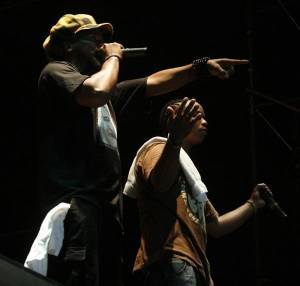
We were taken by our guide and driver to a beautiful old mansion in Havana Centro, that was the home of the AMISTUR offices. AMISTUR is a state run travel agency and the offices were located in a lovely building that was at one time the home of a wealthy Cuban elite. Here we met rapper de Kokino and another rep. The two men are rap artists working for the Cuban Rap Agency. The agency was created as a way for musicians to have a legally sanctioned means of producing and distributing rap music.


The perspective that I left the discussion with was that the Cuban government is seeking to censure the free expression of musical artists by creating a vehicle for these artists to have more freedom to produce and distribute their music. In order for an artist to be a part of the Cuban Rap Agency, they must succumb to the idea of unity of the revolution. Therefore, lyrics that are anti-government are not allowed. The lyrical content of rap that is promoted by the agency is "respect to family, respect to woman, and respect to neighborhood". While I can not argue that those guidelines are admirable, hip hop as a musical form has historically been about uncovering social injustices. According to the rapper we spoke to his music does include lyrics that speak of discrimination, and of growing up in a tough neighborhood. But his music does not pin that on the government or the social order that Cuba hs tried to create. I found this very interesting paper online about Cuban Rap, if you care to know more about the topic: http://www.havanatimes.org/?p=61588


The acuario nacional visit was quite interesting.


Add caption


Wednesday, July 18, 2012

Investigating Havana and Recoginzing Perspectives

Itinerary for the Day
Breakfast at the hotel
Architect and city planner lecture
Old Havana tour
Children's theater company dance rehearsal
Met a friend from Cuba at the hotel and we walked to dinner at a palador (private restaurant)

The Cuban Revolution was fought by people that believed they could change their society and their world. In the early days of the revolution the vision of changing social organization of society was connected to changing the unjust social order full of social inequalities that had persisted on the island since colonial times. Prior to 1898, Cuba was a Spanish colony, bringing in much wealth through sugar production, mining, coffee and the slave trade. It was an export economy, with the profits from the exports, going to a small number of land holders. The revolution sought to bring about egalitarian reforms and the people that enacted the new laws and policies, did so boldly.

Home Ownership in Cuba
After the revolution in Cuba, owners of the plantation lands had their social status and property holdings turned upside down with the keys to the house given to the servants that worked in it, and the previous owners given jobs as field workers. The opulent urban mansions were also taken from their owners and given to the servants. The previously wealthy class, now worked for their servants. Most of the upper and middle class Cubans emigrated to the United States as the revolution claimed victory, leaving behind empty houses, that were then allotted to Cubans that stayed in Cuba. This is mainly how initial home ownership occurred in Cuba. During the time of the Soviet Union's subsidies in Cuba, Soviet style apartment buildings were erected throughout the country, and people were these given homes for small lease fees. Ownership of homes transferred to family members through inheritance, sometimes with legal swapping. In 2010, the Cuban government made reforms in the economy which allowed Cubans to buy and sell their homes.

We had a wonderful lecture in the morning with Miguel Coyula, an architect, city planner and scholar. He was very informative and shared information about Cuba in general, about the development of old Havana, Havana Centro, and Miramar and west of the city, and the new direction home ownership was taking in Cuba. 90% of Cubans own their own homes at this time. 
inside a Soviet style apartmentAccording to Coyula, the ability to buy and sell property has created a new societal dilemma for the social order of Cuba. His example was that he bought his house for $650 and today he could sell it for $120,000. This is a major problem for young people that no longer have access to inexpensive housing to buy, and the government has been strapped for funding of new housing to meet the demand. Coyula said that there were no mortgages in Cuba under the old planned economy, instead people were given their housing and signed a lease with the government to pay off their debt in small amounts each month. This was not exactly a mortgage as there was no interest charged. Question- does interest exist. Answer yes and so do loans. A topic of further research.

Another interesting point: If Cubans chose to emigrate from Cuba, they lose possession of their Cuban citizenship, and any home that they own goes back to the state.

Scenes from the days touring:
Breakfast at the hotel


The Malecon in Havana

ICAP House in Havana

Church in Old Havana

Old Havana

Old Havana - Mural of the intellectuals that designed and inhabited te city during the colonial times.

Tuesday, July 17, 2012

Hello Havana - July 17


On the plane flying across the straits of Florida and into Havana. A very short distance in miles, but a huge distance In culture and lifestyle, or so I believed. Havana here we come.


We started off with some difficulties in having comfort zones pushed and getting oriented to a new environment. After a quick and beautiful flight and landing in Havana, we spent time in customs, a considerable amount of time. We were first questioned by an agent as we were waiting in line to go through customs. Miriam was pulled aside by the agent and taken away from the group. I followed Miriam, because there was no way I was letting her out of my sight. The customs agent took our passport numbers and wrote them down on a piece of paper, and he proceeded to ask us a series of questions recording our answers on the piece of paper. He asked about what we did and why we were visiting. How long we would be in Cuba and where we would be staying. We answered all questions truthfully with Miriam doing most of the talking. We were questioned for about 15 minutes. It was quite an interesting start.

Next we all lined up to go through the customs checkpoint and enter the door to baggage claim. Julie went first. Then it was Miriam's turn and she ended up calling me to go with her. I tried to explain we were all a group, and tried to get the female agent to let us all come up together, but she would not allow it. She carefully examined our documents, took our pictures on a web camera and allowed us to walk through the door.  The rest of the group were able to get through rather quickly.

Once through the door, the baggage claim area was a place with baggage littered all over the floor and some of the baggage actually coming onto the carousel. Julie and Carl's bags were held up and Julies bags apparently had some items in it that caused customs to question what our intentions were with gifts. I ended up opening my bags to convince them that we only had a couple of items to give away as gifts, like string backpacks, and colored pens. This seemed to have satisfied the agent and she allowed us to leave with our tour guides.

The tour guide's name was Joe (yoel) and he seemed to know a lot about Cuba. He claimed to have two master's degrees, speak five languages, and to be expert in many subjects including history. Our first stop waPlaza de la Revolucion - Jose Marti statues the plaza de la Revolucion. I didn't realize that the monument began construction under Bautista. The plaza was built to first honor Jose Marti, a national hero of Cuban independence. The girls loved taking pictures of the Che outline on the side of the building. It was quite interesting that vultures were circling around the top of the government tower building.

Hotel Paseo, our new home in Havana. We arrived at our hotel around 330. Carl, Julie, and Marina were tired and wanted to take a nap and me and the other five girls wanted to explore around and get the lay of the land. We walked a good long way all the way to the malecon. The markets we encountered were quite interesting as there was not much food in them. Bananas and a bit of other fruit were pretty much it. It could be that we need to look closer to really see what is there. The boys and men on the street were very interested in the girls, and smooched at them often. I learned not to use dollars on the street as they are illegal. It was a great way to get acclimated. I was surprised to see the markets and I took pictures of many of the businesses I saw. Later I will try and determine which businesses are state run and which ones are private.

We got back to the hotel and quickly changed for dinner. Our driver and guide was there and took us to El alhibe for dinner which was located in Miramar. Funny thing, I grew up in a suburb in Florida named Mirarmar. Miramar it appears was added onto Havana during the 1920's through the 1950's. The upward mobility offered by middle management positions in Cuba from mostly US corporations, allowed for a growing middle class and middle class suburban communities. Most of the houses in Miramar were abandoned during, and a few years following the 1959 revolution. Abandoned homes, along with homes owned by US citizens, were taken over by the government after the revolution. 

Speaking of home ownership, a very interesting fact: 90% of Cubans own their own homes. This fact was said to us by three different officials, and people that owned their homes. Another intersting fact: three houses fall down from lack of maintainance in Cuba every day.


The dinner was very good, and the beginning of the question of "Chicken, fish or pork" began. Our dinner choices would be this for the duration of the trip. The girls were able to get a coca-cola which excited them. The area that the restaurant was in was quite nice, and the houses appeared to be pretty well maintained. I would come to find out that people in Miramar lived better than people elsewhere on the island. In fact, we ate more food than many Cubans have the luxury of. We were the only people in the restaurant.

Havana CentroMost of the businesses, restaurants, taxi cabs, hotels, markets, and other places to obtain goods and services are owned and operated by the Cuban government.


This old US car was likely owned by someone that operated as a private taxi business. The private taxi business is one way that Cubans, if they are lucky enough to have a car, can earn a very good living.